

_edited_edited.png)

Film Review - Tony: a culinary coming‑of‑age and the making of Anthony Bourdain

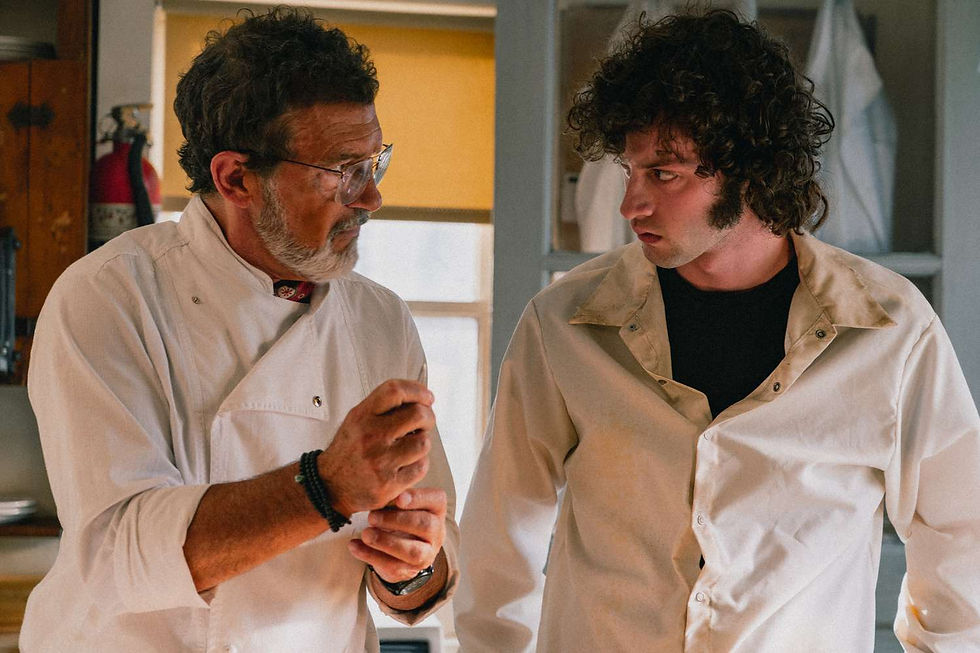
Tony is a movie of soil and seeds: a young Anthony Bourdain moving through the early encounters that will shape his life, miscreant line cooks, the first kitchen skills like shucking an oyster, drugs, booze, sex. These are the seeds scattered across him, and he is raw matter where the forces that will shape his life begin to germinate.
This indie‑biopic had its world premiere at the 2024 Telluride Film Festival and is now rolling out in limited release. It takes place over just a few months in Provincetown, where he has followed his high‑school crush Nancy (Sarah Desjardins) after being rejected for a writing scholarship. He arrives penniless, gets into a brawl, and lands a job as a pot washer. He lies to Nancy, keeping up the pretence that he is a writer as he attempts to woo her across various scenes.
Provincetown is a coastal town in Cape Cod, and the patron of the Flagship restaurant, played by Antonio Banderas, gives him a job in his shellfish kitchen. Working there, he encounters Sal (Michael Mando), who introduces him to weed and coke. Sal is Bourdain’s Sal Paradise (On the Road is referenced several times), a chaotic magnetic character who drags him into the underbelly he’ll later mythologise. Meanwhile, he endures long, brutal days in the kitchen where he learns the hard way, collecting black eyes, burns, beatings, and being woken every morning by Banderas, whose hammock he is sleeping in, with a bucket of cold seawater.

Johnson gives the film a coming‑of‑age texture, shooting Provincetown in sun‑bleached technicolour, with clothes and styling that anchor it in seventies culture. Jaws is showing at the local cinema. Close‑ups on the beach, in the kitchen, on stairwells, and through the window of a pizza place emphasise how tightly the film is contained. It is a capsule where Bourdain begins. The soundscape is equally vivid: the hiss of steam, the clatter of pans, the barked orders at the pass. It’s a sensory world that captures the paradox at the heart of Bourdain’s formation, the refinement of food and taste emerging from grimy, punishing kitchen labour.
Banderas (the character is just know as Chef or Patron), keeps a painting in the kitchen, a portrait of a chef who killed himself after the fish for his perfect banquet failed to arrive. It’s a signal that culinary excellence demands discipline, obsession, and sacrifice, and a hint of the path Bourdain will eventually choose. Banderas is the mentor and counterpoint to Sal’s chaos: he maintains order and is the gentle north star pointing toward craft and mastery, the path Bourdain will ultimately follow.
Meanwhile, Bourdain’s ambition to be a writer is portrayed as conceit, cut down mercilessly by the people he works with. He learns that nothing comes easy, but he also learns about food, kitchens, and restaurants.
The oyster is central to the character of Bourdain. He writes in Kitchen Confidential about tasting one for the first time on a family holiday in France, and director Matt Johnson runs with the oyster as a metaphor for Bourdain’s development throughout the film. On the outside, it represents him learning his craft; on the inside, it hints at his quivering entrance into the culinary world and adulthood.
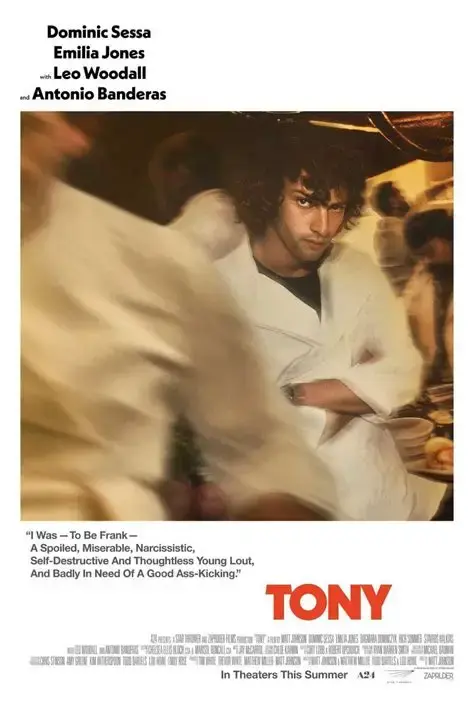
Dominic Sessa (The Holdovers), who plays Bourdain, captures the conceit and vulnerability of a young man drifting through seasonal work, and he nails Bourdain’s voice with uncanny precision. There’s no romanticism: we see him grubby, lanky, dirty, wandering around in his underpants, stripped of myth and charisma. It’s also unmistakably a different time, his pursuit of Nancy would now be seen as stalking, and the macho kitchen brigade shows exactly what’s toxic in that environment. We’ve had to wait for shows like Burning Point and The Bear to expose how wrong this culture is; Tony simply presents it as the water he’s swimming in.
In the end, the young Bourdain, through a series of blunders, starts to come clean. He tells the truth to Nancy and accepts that he is going to be a cook rather than a writer. The film closes with him interviewing for the Culinary Institute of America, no triumphant denouement, no sudden success or romance, just the beginning of honesty and the willingness to work. When the chef‑interviewer looks at his CV and says, “It looks like your experience is only a few months as a dishwasher,” Bourdain replies simply and truthfully, and gives his name as Anthony, not Tony. This signals a shift: the shedding of pretence, the start of discipline, and the first step toward the person he will become.
I went along to see the film hoping that Matt Johnson would not romanticise Bourdain, and he doesn’t. Instead, he shows a real human, warts and all, and stays true to character. That honesty allows us, as equally flawed humans, to recognise the young Anthony Bourdain, the insecurity, the false bravado, the dubious morality, the hunger to become someone, and in doing so perhaps reveals why Bourdain in turn could later engage with empathy with so many people globally.
Tony is a culinary coming‑of‑age film that explores the less familiar corners of Bourdain’s early life, but anyone who knows his later body of work will recognise it as a valuable touchpoint: the messy, unvarnished beginning of a man who would eventually learn to see the world with curiosity and care.
Tony
Dir. Matt Johnson
Cast: Dominic Sessa, Sarah Desjardins, Michael Mando, Antonio Banderas
2024 | 1h 52m | USA
World Premiere: Telluride Film Festival
Release: Limited theatrical (Elevation Pictures)


